Saturday, August 6, 2011

Christiansborg Castle: The Ruins

So as I mentioned in the previous blog post, the Ruins underneath the Castle deserves its own blog because there was so much history down there and I took lots of pictures. I really enjoyed learning all the unique history and looking at all the artifacts.  


During the year of 1000 a small town called Havn (Haven), today knows as Copenhagen, grew into a small trading center at the coast of the Sound. King Valdemar the Great gave the town to Bishop Absalon of Roskilde, who in 1167 raised a castle at the shores before the town as a defense against pirates. Havn was a ferry station between the provinces of Sealand and Scania as well as a trading center and a fishing hamlet. During the Middle Ages the sound was tilled with shoals of herring, sometimes in so large numbers that it was possible to scoop up the herring from the sea. 

Denmark was marked by troubles and going through a time with several kings in the middle of the 1100s. It did not come to an end until Valdemar the Great became the only king of the country in 1157. Then Valdemar and his allied began to build castles up and down the country in order to invigorate the power of the kingdom.
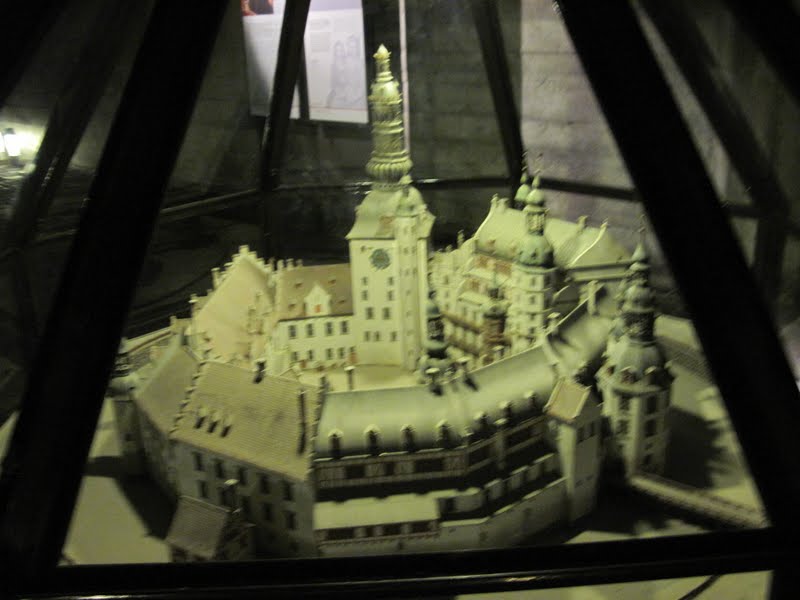
In the ruins it is possible to see the remains of two buildings: Bishop Absalon's Castle and Copenhagen Castle. The Castle of Bishop Absalon of Roskilde was built in 1167 and destroyed in 1369, after which Copenhagen Castle was built.

Both buildings consisted of a ring wall. Inside the wall were the Castles' buildings and from the high ring wall it was possible to fight down the enemy.


The toilet of the time was a "secret"; it only consisted of a drain, which ended right below the ring wall. The drain to the left belonged to a house inside Absalon's Castle. The drain to the right is the bottom of a shaft, which have been leading up to a toilet on a floor higher up in the tower.


The ring wall continues behind the tower. This means that the tower on Absalon's Castle is a later extension to the ring wall.  The ring wall is built of limestone, while the tower is built of rocks. It was not until the end of the 12th century that bricks became a common building material. The tower of the ring wall became part of Copenhagen Castle as BagertÃ¥rnet (the Baker's Tower). This can be seen on the outside of the tower, where new bricks have been added. 


Absalon's Castle was built of limestone, which together with other kinds of unhewn stones was a natural building material in the medieval Denmark. The limestone for the building of Absalon's Castle came from Stevns Klint, where blocks were sawed out by stone cutters, while the chalk still was humid and soft.


Most of the castles had a ring wall with embrasure. Each man had a place by the embrasure and was responsible from an area outside the ring wall to fire at. Inside the Castle's wall machicolations made it possible to pour down boiling oil or tar over the enemy. n 1306 the Norwegian navel forces attack the Castle but they are unsuccessful. Absalon's Castle was attacked several times by the Wends, a Slavonic people who lived at the southern coasts of the Baltic Sea. The Wends worshipped a four-headed God named Svantevit to whom they sacrificed in a large temple in Arkona on the island of Rugen.

In 1368 during the reign of Valdemar Atterdag, Copenhagen was conquered by the united enemies of the king led by the Hanseatic towns of northern Germany. After a siege of one and a half month, the castle had to surrender.  One of the ultimate objectives of the war was 'simply to destroy and ruin the house in Copenhagen."  This objective was reached in 1369, when 47 Hanseatic stone cutters destroyed the castle and left it in ruins.

After the destruction of Absalon's Catsle, the importance of defending Copenhagen still existed. Consequently, the Bishop of Roskilde built a new castle, which was taken over by the Danish King Erik of Pommerania in 1417. Since that time, the castle has been known as Copenhagen Castle. The large tower of the Copenhagen Castle, the Blue Tower, was built in the 15th century. It was a tower of defense, but later on it became famous as a state prison. Both poor and rich people could end up in the dudgeons of the Tower.  The Tower was constructed up against the ring wall. 
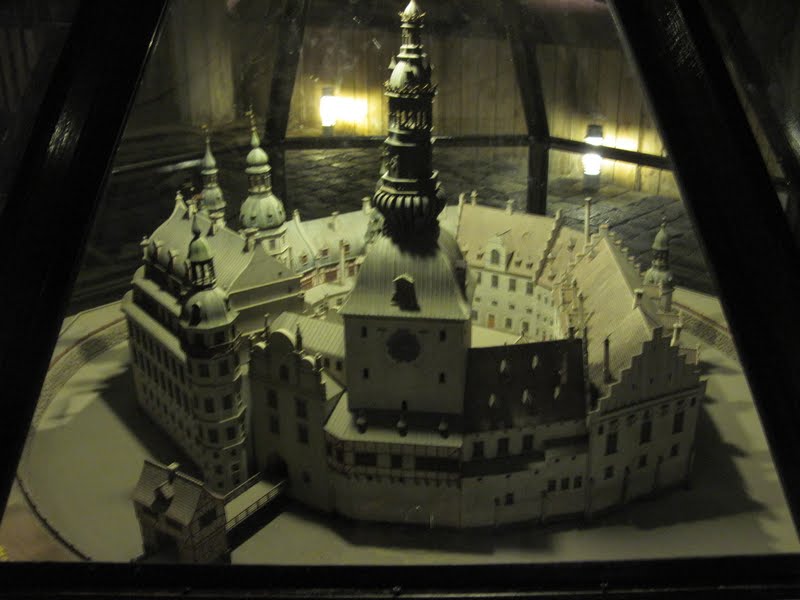
From 1417 Copenhagen Castle served as the residence of the Danish Kings wen they visited Copenhagen. Only after the introduction of the absolute monarchy, it became the kings' permanent residence.  Leonora Christina is probably the most famous prisoner, who has been locked up in the Blue Tower.  Nevertheless, she was not imprisoned in a dungeon, she had a room on one of the floors upstairs. She was a prisoner from 1663 to 1685.  Leonora Christina was the daughter of King Christian the Fourth but spent close to 22 years in the Blue Tower, a prison at Copenhagen Castle. Her husband, Corfitz Ulfeldt took part in Sweden's attack on Denmark in 1658. The new King Frederik III, accused Leonora Christina and her husband of treason.

In May 1685, Leonora Christina was finally released from the Blue Tower by King Christian the Fifth. She was 64 years old but had not forgotten that she was a princess. She demanded to leave the Blue Tower in style and waited in her cell until a carriage was sent.

In 1731, Copenhagen Castle was torn down in order to be replaced by the first Christiansborg Palace. For the new Palace, conduit pipes were established through the ruins of the two former buildings. The ruin of the Blue Tower has no longer its original size, as some of the stones were used for the construction of the first Christiansborg. In 1728 Copenhagen was on fire, and consequently, it was necessary to reuse the building materials.

The crypt of Viborg cathedral, built ca. 1150 gives an idea of the kind of romanesque architecture represent by the church stones.


Stoves like this one have been placed at Copenhagen Castle, the first and the second Christiansborg. Every winter small fires broke out in the poorly cleaned and superheated stove pipes.  It is considered to be the cause of both fires of the Palace in 1794 and 1884.  The fire buckets were found at the loft of the present Christiansborg Palace. The buckets are dated back to 1742 and 1781 respectively.  They have probably been used for fighting both fires of the Palace.

The cause of both fires was presumable the result of a sooten-up, superheated stovepipe.  In 1794 the palace had no fire walls and behind the walls there was a system of canals and stovepipes. Through this system of canals and pipes the fire spread quickly from floor to floor. 

In the October 3, 1884 (second fire) many valuables were saved from the flames of the second Christianborg Palace, but the main building burned out. The royal family did not live at the Palace but even so King Christian the Ninth and his sons participated personally in the rescue operations.  The fire broke out under Riddersalen (the Great Hall) in a stove and it spread through a similar system of pipes and canals like the fire of the first Palace.  The firemen did not know the system very well, so despite firewalls, irons doors, fire engines and hydrants, the Palace burned down in one day.

Originally this stone was a part of the decoration, probably from the first Christiansborg's Great Hall. Later it was turned over and chipped as a cornerstone for the projection of the front on the second Christiansborg. 
The left half of the pilaster capital from the facade facing the courtyard of the second Christiansborg. 
The upper part of a column in a flat relief on a wall, also known as a pilaster capital, originates from the decorations of the first Christiansborg. 
Today Christiansborg Palace houses several different institutions. In one of the wings of the Palace's main building resides the Folketing (the Parliament). The Royal Reception Rooms are located in the other wing.  Above the reception rooms, the Prime Ministry's Department is placed in an apartment, which originally should have been the residence of the royal family. Furthermore, the Supreme Court resides at the Palace. 

Thank you for all your love and support.

Thursday, August 4, 2011

Christiansborg Castle

On Friday, May 19th (National Prayer Day in Denmark) I decided to make a trip to Copenhagen to see the Christiansborg Castle. This castle has a lot of history and is not to far from the Copenhagen central station.  For about 100 dk ($20) I was able to buy a ticket to see the three main sections of the Castle; the ruins, the official meeting rooms and the stables.  However because of the lack of time I did not go to the stables because I just spent too much time in both the ruins and the meeting rooms.  I did not mind much that I missed the stable tour cause I can see it again some other time, I am not worried.

When you walk up to the Christiansborg Castle, the large court yard with the fountain create a wide open area to really look at the entire castle.  When you get closer the castle you can see the detail. The statue in front of the castle is of King Christen IX (9th). 

King Christen IX, King of Denmark from 1869-1906
Looking up at the tower you can see the detail. I was later told that say day that the three crowns on top are for the Danish, Norwegian and Swedish crowns. Even though the King never had the Swedish crown he felt that he should have.
Even the small gateway stones on top had great detail in them.  This stone with the crown craved on top shows the royal seal: Three lions with nine hearts.  When I first arrived to Denmark I always wondered 'what is up with all these red hearts everywhere?'  Now I understand.
What surprised me and confused me at first was the 'front door' and what was behind the front door.  When I think castles - I imagine a huge elaborate front door with some great hall behind it with paintings on the wall and great chandeliers hanging from the ceiling.  But behind this front door was a hall to another side of the castle with some statues etc inside the hall.


When you walk in this front hall there are two large statues or memorials on either side. On one side there was a plague with surround by Danish flags and three states of influential people.
On the bottom right of this picture is the entrance to the ruin exhibit. But since I have so many pictures and lots of history to share about the ruins, I am making another blog post all about the ruins exhibit.

1659 -- 1909
eleventh February
Copenhagen citizens put this memorial in remembrance of their fathers' bravery and unity which rescued the city from destruction and saved Denmark's rich


On the other side of the hall there was large memorial or statue .. I am not sure what you would call it.
In the middle there is some writing in Danish and the royal seal. I have tried a few times to translate what is written but I am not quite sure. I plan on asking one of my many native Danish friends if they can translate it for me.


After some looking I was able to find the entrance to where the meeting rooms are. The front door and the ruins in the middle of the castle where as the entrance to the meeting rooms that are open for public viewing are on the on left portion of the castle.  The entrance was mostly marble with these beautiful statues.


Now after I pass the threshold I have to turn off my camera. no cameras or video cameras allowed.
I must the rooms in this portion of the castle were amazing. The detail in the flooring, the curtains, the paintings every square inch of the place was amazing.  I took the informational tour and learned so much about each room and some of the paintings.  Even though I could not take pictures inside the meeting rooms, I was able to purchase postcards of certain meeting rooms.  When I got to work the following week, I was able to scan the postcards before I sent them off to family.

The royal throne room had a unique felt like wall paper that had the royal seal printed all over it. The two throne chairs were saved from the second Christianborg Castle fire.  In this picture you can not really tell but on the floor there was a unique star pattern in the middle of the room. The tour guide mentioned that when the Queen greets official guests while standing on this star.  Also not shown in this picture is the ceiling, on the ceiling right above the star pattern is a hand painted memorial showing how Denmark got is flag.   I have been told that during a battle (I cannot remember which one) a flag feel from the Heavens and became the Denmark National flag.

Another room I toured was the dinning room, which had a huge dinning table. It was large enough to fit 50 people. And the wood table was made out of an old wooden navy ship. I can not remember which navy ship.


Another room I toured was the Roman room. In this particular room there was amazing. There is not much to say about this room, I think this picture says it all. I really enjoyed every moment of my trip to Christiansborg castle.

Tuesday, July 26, 2011

Roskilde Viking Muesum

In another building on the museum grounds is where five viking ships are on display. It was really interesting to see that much history in one place. I hope you enjoy all the pictures and all the information I got while there. 
 
Five Viking Ships

Towards the close of the Viking Age -- presumably at some time between 1000 A.D. and 1050 A.D. - the fairways of Roskilde Fjord were blocked by a series of barriers to protect the important trading town of Roskilde from attack by enemy fleets. The five Viking ships in the museum come from one of these blockages in the Peberrende channel at Skuldelev, 20 km North of Roskilde. Here, there ships were sunk across the channel and boulders heaped up on top of them. A little later the barrier was strengthened by the sinking of a further two ships at the spot.
It was at a time when Norwegian Vikings were ravaging Denmark but we have been unable to link any definite historical event with the blockage.

The blockage manifested itself as a ridge of stones. It had always been known to fisherman in the fjord and local tradition claimed that it contained a ship sunk at the command of Queen Margrethe I. It was not until underwater excavations were carried out by the Danish National Museum between 1957 and 1959 that it was established that the blocked dated from the Viking period and contained not just one but serval ships.


The Excavation

In 1962 a cofferdam of sheet piling was built around the blockage so that it could be drained. In a period of less than four month all five ships were excavated and brought to the land in thousands of fragments.

The find was significant not just because it consisted of five ships but because these represented five different types of ship which together provide a good indication of the impressive range of activity of the Viking-age shipbuilders.


The ocean going trader
                                                                     
Wreak 1 is a sturdy, ocean going trading vessel possibly of the knave type.

The ship was built of stout pine planks at Sognefjord in Western Norway and was later repeatedly repaired with oak near Oslo Fjord and in Eastern Denmark.  The ship had desks fore, aft, and an open hold amidships.


The ship and its cargo may have been owned by a magnate, who used it to sail on trading expeditions with his clan or coorperatiely by a group of merchants who sailed it in order to trade at markets. The crew would have consisted of 6-8 men. The ocean - going vessel could have sailed all over the North Sea and the Baltic as well as in the North Atlantic.  With a favorable wind, it probably maintained an average speed of 5-7 knots.


 The great longship
Wreck 2 is an ocean going warship possibly of the skied type and can carry a crew of 65 to 70 warriors. The long narrow shape of the ship allowed a great speed and the manning of 60 oars made it possible to keep the ship moving even without wind.

The ship was built of oak. Tree-ring analysis of the timber has shown that the ship was built in the vicinity of Dublin about 1042. Vikings settled in Ireland in AD 800 and established several fortified bases along the Irish coast. these bases developed into towns with Dublin as the most important. Here the Vikings lived as merchants mercenaries and shipbuilders.


The Coastal trader

Wreck 3 is a small elegant trading and transport vessel, possibly of the 'byrding' type. The ship was built of Danish oak. It has decks of loose planks fore and aft and an open hold amidships with room for about 4 tons of cargo. The ship had a crew of  5-8 men.


 The ship may have been used by a farmer and his associates traveling to a market or meeting at an assembly.

It was well adapted for sailing in Danish coastal waters and in the Baltic. Wind was the most important means of powering the ship but the oars could be used when manuring or when traveling short distances in calm weather. An average speed of 4-5 knots could be held in favorable winds.


The small longship


Wreak 5 is a smaller warship, possibly of the snake type.

The ship was built of Danish oak, ash, and pine, partly by reusing timber from other ships. With 13 pairs of oats and about 30 warriors, it belonged to the 13-sessers, the smallest longship in a war fleet.  Along the sheetstake there are fragments of the shield-rack, on which shield were placed and on the 6th strake on the port side aft, carved decoration can be seen.

The ship was ideal for sailing in Danish coastal waters and through the short, choppy waves of the Baltic. An average speed on longer voyages would have been 6-7 knots in the favorable wind, with a top speed of about twice as much.


The fishing vessel

Wreck 6 is a combined rowing and sailing vessel probably built for fishing and whaling or seal hunting. The ship was built of pine planks near Sognefjord in Norway. Later, an extra plank was added to increase the height of the side in order to transport more efficiently carafes of fish, other trading goods or people. During the alteration, the original rowlocks were removed and the number of oars reduced. the conversion presumably meant that the ship was used more for transport and less as a fishing vessel and that is sailed with a smaller crew.  The bottom of the hull had been repaired with oak planks from South Scandinavia before the ship was scuttled.